Pentagon Review of Close Combat Training Standards is Long Overdue
In 2015, the Department of Defense initiated an unprecedented social experiment with women in combat arms units such as the infantry. Pentagon officials promised that female trainees headed for previously all-male units would have to meet the exact same standards as men. Ten years later it is fair to ask, has the experiment played out as promised?
We are about to find out. On March 30, Secretary of Defense Pete Hegseth issued a Memorandum calling for a 60-day review to achieve high, uncompromised standards in combat arms units such as the infantry, Special Operations, and other occupations with extraordinary physical demands.
Thanks to a series of Executive Orders that President Donald Trump issued since January, Hegseth’s 6-month implementation period should proceed without equivocation or distractions related to percentage-based diversity, equity, and inclusion (DEI) quotas. Wrote Hegseth, “[I]t is essential to identify which positions require heightened entry-level and sustained physical fitness.”
An honest review of contemporary policies regarding women in the military should reflect sound priorities unrelated to DEI. Career opportunities in the military are important, but if there is a conflict between careers and the needs of the military, the needs of military must come first.
Direct Ground Combat Goes Beyond Being “In Harm’s Way”
In January, the Center for Military Readiness challenged the incoming Trump Administration and the 119th Congress to take a fresh look at all policies affecting women in the military:
- CMR Policy Analysis: Contemporary Information About Women in Combat Policies
Implementation of Hegseth’s order must begin with clear definitions of terms, starting with “direct ground combat.” (DGC). Direct ground combat arms units such as the infantry, armor, artillery, and Special Forces in all branches of the service are trained to seek out and attack the enemy with deliberate offensive action.
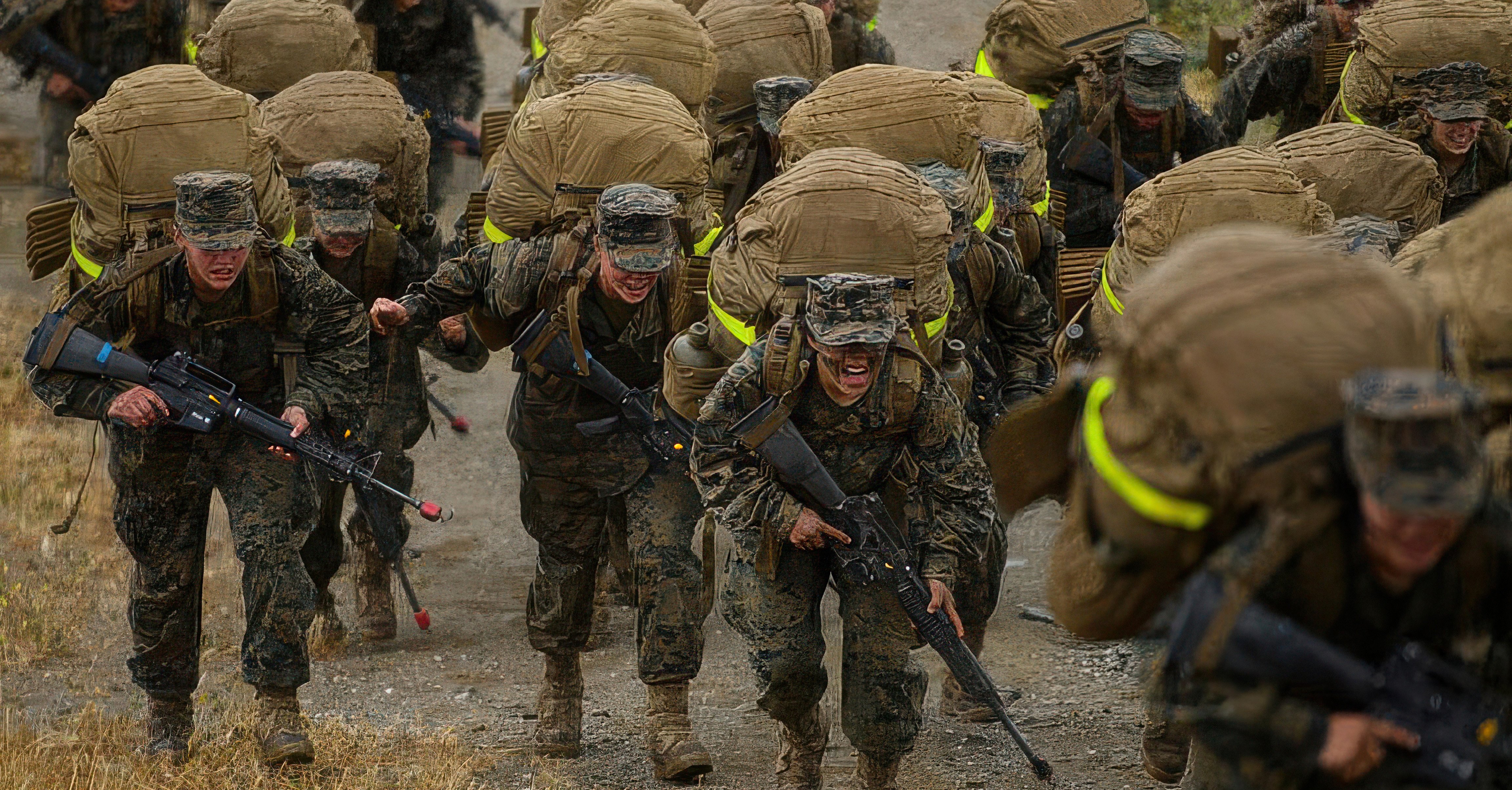
Physical demands in DGC units typically are greater than those in units and military occupational specialties (MOSs) that serve “in harm’s way” in war zones. Men and women serving in such roles are at risk of contingent or incident-related combat, and those that come under fire are trained to fight back and return to base. Their mission, however, is not to seek out and engage the enemy with deliberate offensive action.
Medical technicians, truck drivers, intelligence teams and other support troops serve with courage, and all must be prepared for wartime contingencies. More than 150 military women have died during war operations in the Middle East since 9/11, including two female Marines who were killed by a suicide bomber during America’s chaotic withdrawal from Afghanistan in 2021. CMR has recorded the names of these brave women here:
It is not necessary, however, for all personnel to meet the same physically demanding standards as infantry, armor, artillery, or Special Operations forces. Nor should tough standards in those units be lowered or “redefined” to meet DEI goals.
Empirical Data Ignored
Secretary Hegseth’s review of contemporary training requirements also requires an honest review of recent history. In 2015, Secretary of Defense Ashton Carter opened to women all units and military occupational specialties, including previously all-male infantry, Air Force Special Forces, Army Green Berets and Navy SEALs.
In doing so, Carter disregarded empirical data indicating that his egalitarian policies would compromise standards and effectiveness in close combat units.
From 2012-2015, the Marine Corps conducted a scientific study of the issue, which included nine months of field tests overseen by the University of Pittsburgh. The purpose of the research was to prove a simple hypothesis: “An integrated unit under gender-neutral standards will perform equally as well as a gender-restricted unit.”
However, despite positive expectations for field tests conducted with well-qualified female and average male volunteers, USMC field test data disproved the hypothesis. As CMR wrote in a Statement for the Record submitted to the Senate Armed Services Committee on February 2, 2016, a Summary of empirical data gathered by the Marine Corps’ Ground Combat Element Integrated Task Force (GCEITF) during that study revealed facts that are still relevant to discussions today. For example:
- All-male task force teams outperformed their mixed-gender counterparts in 69 percent (93 of 134) of ground combat tasks. Physical differences were more pronounced in “specialties that carried the assault load plus the additional weight of crew-served weapons and ammunition.”
- In gender-mixed units, physical deficiencies had negative effects on the unit’s speed and effectiveness in simulated battle tasks, including marching under heavy loads, casualty evacuation, and marksmanship while fatigued.
- Significant differences also were noted in the mixed-gender units’ ability to negotiate obstacles and evacuate casualties.
- During the GCEITF assessment, musculoskeletal injury rates were double – 40.5% for females, compared to 18.8% for men.
These results supported a September 17, 2015, Memorandum from then-Marine Commandant Gen. Joseph Dunford requesting that some close combat units remain all-male. (The Marines have refused to release an unredacted copy of the Dunford Memorandum.)
Secretary Carter ignored the Commandant’s rational request and opened all close combat positions to women for purposes of “equity.” Secretary Carter also promised to maintain sex-neutral (identical) training standards for the combat arms, but that promise proved impossible to keep.
When “Equality” is not Equal
In 2018, then-Chief of Staff Gen. Mark Milley announced that the Army would replace the long-standing Army Physical Fitness Test (APFT) with a more challenging six-event Army Combat Fitness Test (ACFT).
The ACFT was supposed to have sex-neutral (identical) requirements and scoring systems for both male and female trainees.
However, due to high failure rates among the women, officials tried to improve pass rates by removing the most demanding elements of the ACFT, altering scoring systems, or making some events optional.
Women’s scores improved over several years, but still, only 52% of active-duty enlisted women, compared to 92% of the men, were able to pass the ACFT. Among officers, women’s pass rates were higher – 72% compared to 96% of male officers.
DoD contractor RAND acknowledged in its December 2024 report that tougher standards for combat arms units “may be too high to achieve the Army’s desired pass rates for various ‘subgroups’ (the largest being women).
Ultimately, the Army reinstated sex-normed (different) standards using separate scoring systems for men and women, or by qualifying requirements that are “equal” but less demanding than before, while pretending that nothing had changed.
Physical realities shattered unrealistic theories about sex equality in the combat arms. This is why Secretary Hegseth is correct in directing the various services to clearly define combat arms occupations and provide tough training that saves lives and missions.
Standards for these close combat roles, Hegseth noted, “should emphasize the ability to carry heavy loads, endure prolonged physical exertion, and perform effectively in austere, hostile environments. Service members in these roles must exhibit speed, strength, agility, and endurance to navigate the demands of combat situations.”
All branches of the service should produce honest evaluations of entry-level and advanced training requirements needed in close combat units and MOS’s. As then-Brig. Gen. George W. Smith, Jr., USMC wrote at the conclusion of the GCEITF trials, “An infantry unit must be fully capable of regularly moving dismounted for extended distances with heavy loads. This has been the coin of the realm for Marine infantry throughout history, and [current land combat requirements] place even greater demands on the individual infantry Marine.”
Officials also should determine realistic requirements for other troops who must be prepared for wartime contingencies or hostile incidents while serving “in harm’s way.”
The goal should be to strengthen combat effectiveness, not to advance individual careers or percentage-based demographic quotas.
* * * * * *
The Center for Military Readiness (CMR), founded in 1993, is an independent public policy organization that reports on and analyzes military/social issues. To make a tax-deductible contribution to CMR, click here.
_89x132_1490350447_120x120.png)